A study highlighted by the Forbes Human Resources Council revealed that nearly one-third of office workers still retain access to their former employer’s data and systems after leaving their positions. When this lack of boundary enforcement translates to time and payroll operations, it creates a systemic vulnerability. For enterprises managing large, distributed workforces across multiple locations, departments, and job sites, payroll integrity cannot simply be a back-office concern. It must be treated as a critical compliance risk requiring active governance from the moment an employee clocks in.
For organizations operating at enterprise scale, maintaining audit defensibility requires strict adherence to role-based access control (RBAC), the principle of least privilege, and clear separation of duties. These security models ensure individuals only have access to the data, actions, and approval responsibilities required for their specific job functions.
Effective payroll governance requires clearly defined roles, approval workflows, and accountability structures. Research and advisory firm Gartner emphasizes that effective data governance programs must explicitly define decision rights and accountability to ensure operational data is properly valued, created, consumed, and controlled.
Without these structures, payroll integrity is compromised before data ever reaches the enterprise resource planning (ERP) system.
Payroll Governance Fails When Time Tracking Lacks Enforcement
Enterprise payroll risk often begins in the field, not in accounting. When field supervisors, project managers, and employees have overlapping or unrestricted edit privileges, accountability disappears. Without proper role-based controls, organizations cannot confidently determine who entered, approved, modified, or finalized a payroll record.
Common operational risks include:
- Post-Approval Modifications
Allowing time entries to be altered after a supervisor has already approved the shift defeats the purpose of the approval workflow. Enterprise organizations require clear audit trails that document every adjustment and maintain visibility into who made each change.
- GPS Policy Bypasses
When geofencing or location tracking can be toggled off or bypassed without justification, verification becomes impossible. Enforcing location-based policies at the point of capture helps ensure workforce data accurately reflects where and when work occurred.
- Bypassed Approval Structures
Without a rigid approval hierarchy, critical overtime, custom holiday pay, or exception requests can move forward without proper operations or HR oversight.
If edit rights are universal, tracing the origin of an error or fraudulent entry during an audit becomes nearly impossible. Payroll integrity starts at the punch, not at ERP import.
By enforcing rules at the point of capture, enterprises protect workforce data from human error, unauthorized changes, and intentional manipulation.
How VeriClock Helps Enforce Payroll Governance
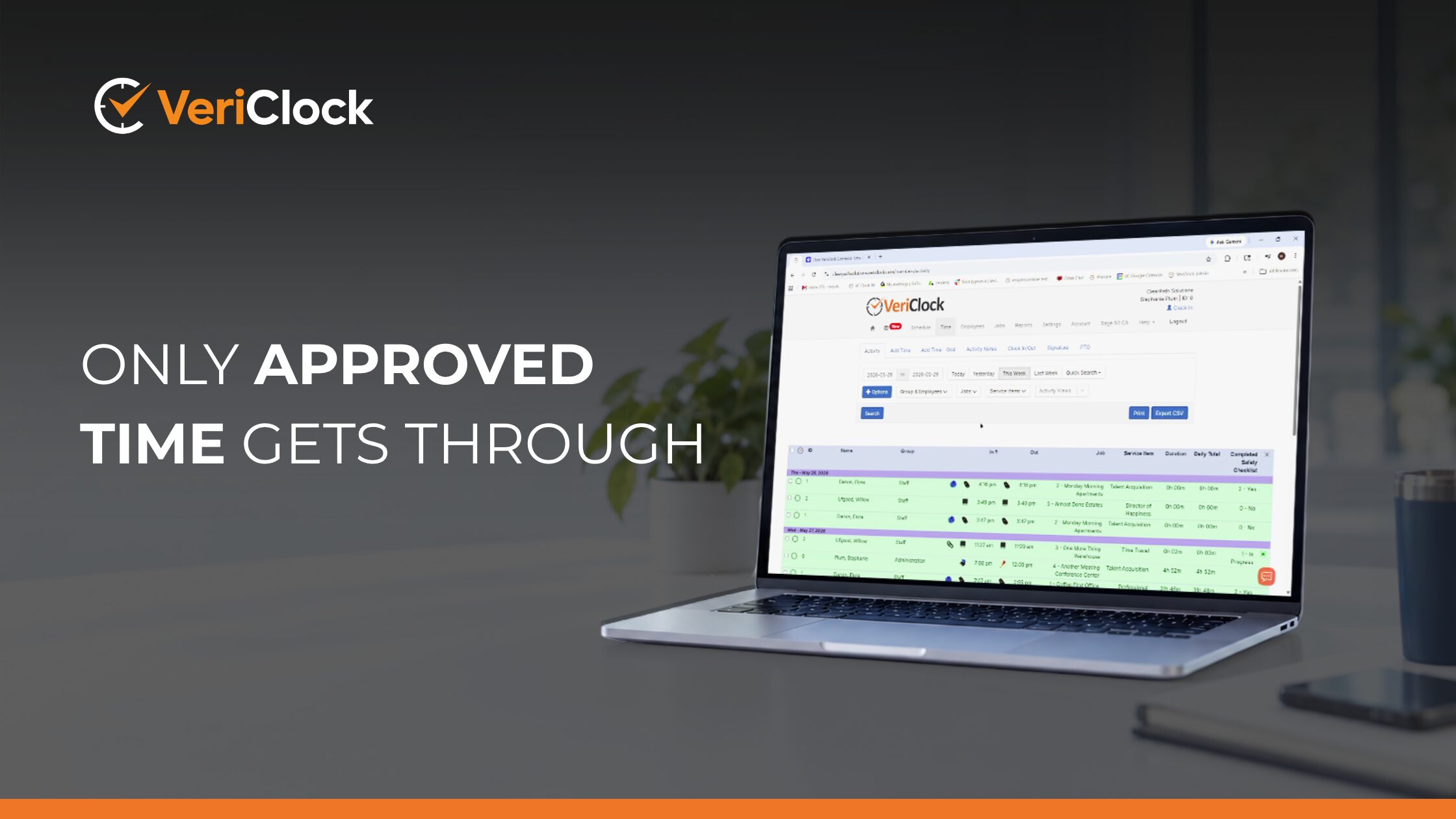
VeriClock provides the controls enterprises need to govern workforce data from the point of capture. Through role-based permissions, time entry validation, service item requirements, reporting controls, and approval structures, VeriClock helps organizations establish accountability before payroll data reaches downstream systems.
With VeriClock, organizations can use Structured Time Entry Validation to ensure time entries conform to organizational policies before submission. Role-based access control (RBAC) helps determine who can submit, approve, edit, and finalize workforce records based on their responsibilities.
VeriClock also provides Duplicate Time Event Prevention to help block overlapping shifts or accidental double-punching in real time. For industries with complex cost coding requirements, such as construction and contracting, Required Service Item Enforcement can ensure employees select valid job codes, projects, or departments before logging their time.
Enforcing Compliance Through Policy-Driven Capture
Securing the payroll data pipeline requires moving away from retrospective corrections and toward automated validation. Rather than expecting HR teams to manually identify anomalies across hundreds or thousands of weekly timesheets, technology must enforce compliance rules dynamically.
Structured Time Entry Validation ensures every entry conforms to organizational policies before submission. This is paired with Duplicate Time Event Prevention to block overlapping shifts or accidental double-punching in real time.
For industries with complex cost coding requirements, such as construction and service trades, Required Service Item Enforcement ensures employees select valid job codes, projects, or departments before logging their time.
Additionally, Custom Formulas in Reports allow organizations to automatically calculate complex overtime rules, shift differentials, vacation accruals, and other payroll requirements. These controls reduce subjective manual adjustments that often create compliance concerns during payroll reviews.
Exception management further strengthens governance by allowing administrators to identify unusual activity, such as unexpected overtime, duplicate entries, or policy violations, before payroll data moves downstream.
Streamlining Data for Enterprise ERP Integration
Clean, validated time data is the foundation of successful ERP integration. When payroll information is accurate, structured, and pre-reconciled, organizations reduce downstream processing issues and improve confidence in their reporting.
Enterprise payroll governance also requires export discipline. Limiting who can generate, modify, or distribute payroll exports helps prevent unauthorized changes between workforce data collection and payroll processing.
Many enterprise organizations rely on deeply integrated accounting platforms. Establishing clear configurations, such as those found in comprehensive ERP setup documentation, ensures systems like Sage 100 Contractor and Sage 300 CRE receive audit-ready workforce data directly from the field.
As enterprise technology ecosystems evolve, organizations need workforce data that is structured and reliable enough to support future integrations with platforms such as Sage Intacct, NetSuite, Acumatica, and Microsoft Dynamics 365 Business Central.
Clean data governance at the point of capture creates the foundation for scalable ERP operations.
The VeriClock Advantage
Securing operational data requires a solution designed for the complexities of enterprise workforce compliance. VeriClock provides the administrative controls, automated validation features, and role-based structures needed to govern payroll data from the very first punch.
Through RBAC time tracking, organizations can control who can submit, approve, edit, and finalize workforce records while maintaining clear accountability across teams and departments.
By utilizing VeriClock’s Permissions / Access Configuration documentation, IT and operations teams can establish strict separation of duties, ensuring only authorized users can modify finalized records. Audit-ready workflows provide visibility into changes while helping organizations maintain defensible payroll processes.
VeriClock’s ERP setup documentation supports organizations as they configure integrations with platforms such as Sage 100 Contractor and Sage 300 CRE, while preparing for future enterprise connectivity needs. Regular updates from the Release Notes hub help system administrators stay aligned with the latest security enhancements and platform capabilities.
Transitioning to VeriClock means replacing manual administrative oversight with automated, defensible payroll governance.
Protect your enterprise from payroll errors, compliance gaps, and audit vulnerabilities. Get a free trial of VeriClock today, or opt-in to our Newsletter and Follow on Social Media to stay informed on the latest strategies in workforce compliance and data security.